Affordability issues plague every province in Canada — but not to the same degree. In Alberta, for example, the cost of living was the second-highest in the country in 2024, based on Statistics Canada’s basic market measure. Not surprisingly, cost-of-living issues consistently lead public opinion surveys in the province, with a recent Abacus poll showing that 64% of Albertans rank it as their top concern.
The UCP (United Conservative Party) government claims to prioritize affordability and has included it in the portfolio of one of its ministers. In practice, however, this priority is nowhere to be seen. The fact that the word “affordability” never appears in the 2026 budget is emblematic of this disconnect between promise and practice. Worse still, key policy choices made by the UCP since it took office in 2019 have deepened, rather than addressed, the affordability crisis in Alberta.
In some areas, UCP policy has been the driving force behind significant price increases. To illustrate this, this article starts by comparing cumulative price changes in three areas — electricity, post-secondary tuition fees, and auto insurance — over the six years before the UCP took office and the six years after.
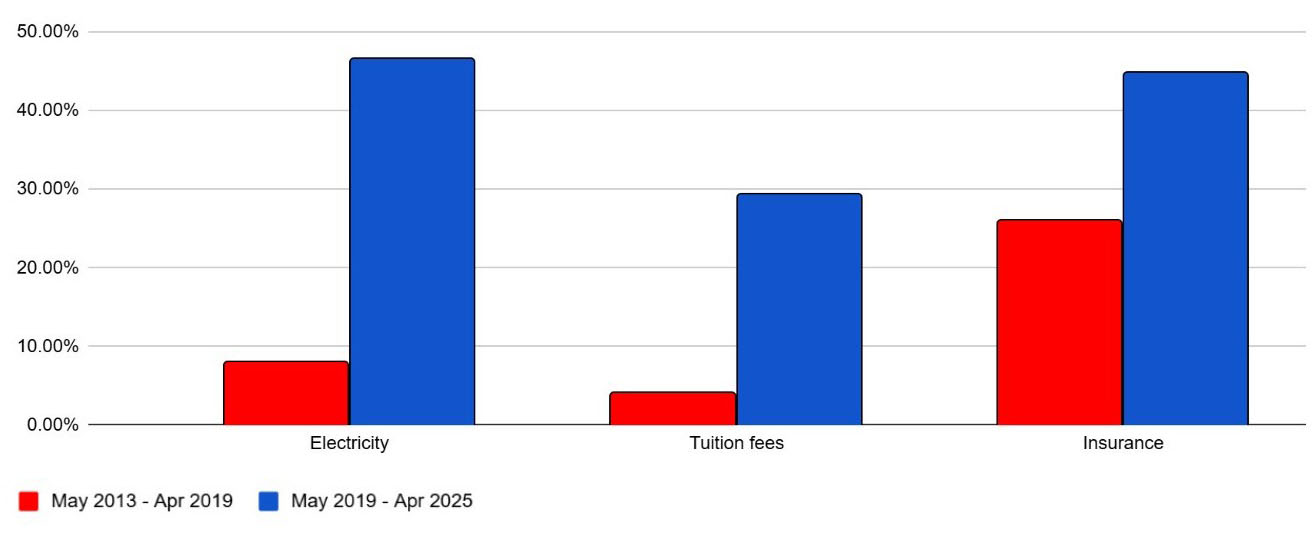
Between May 2013 and April 2019, electricity prices rose by a total of 8%, while between May 2019 and April 2025, they rose by 47% — almost six times as much. Tuition fees followed a similar pattern, rising from 5% in the 2013-2019 period to 29% between 2019 and 2025, while auto insurance premiums increased by 26% in the 2013-2019 period, versus 45% between 2019 and 2025.
Cumulative Price Growth Over Six-Year Periods (%): Electricity, Tuition Fees, and Auto Insurance, Alberta, May 2013-April 2019 and May 2019-April 2025
Source: Calculations based on Table 18-10-0004-01 Consumer Price Index, monthly, not seasonally adjusted, https://doi.org/10.25318/1810000401-eng
Electricity
The massive increase in the cost of Alberta electricity in the last six years can be explained by a combination of the exercise of market power by large electricity generators, heat-related weather events causing increased demand, a surge in natural gas prices globally, and a shortage of power plants due to the lack of investment by private electricity companies.
In 2001, Alberta became the only province to deregulate electricity generation. Since then, the province has experienced several instances of supply falling short of demand, with electricity sold at prices higher than the marginal cost of production. In the words of professor of economics Junaid Jahangir, “insufficient capacity and market power are characteristic of the deregulated electricity market.”
Energy economist Edwardo Sepulveda estimates that, between 2001 and 2024, Albertans paid $24 billion more for electricity than they would have if prices in Alberta had been in line with those in the rest of Canada.
A few options were always available to the Alberta government to reverse this longstanding trend and secure stable prices and supply. One would be to return to a regulated electricity market. This could be done using the existing Alberta Utilities Commission, which currently regulates electricity transmission and distribution. In addition to re-regulating, the Alberta government could create a public entity for electricity generation by gradually acquiring privately held power generation infrastructure, as well as building new infrastructure, including for renewable energy.
Instead, the UCP has resorted to measures that have deferred the problem or provided temporary, partial relief. For example, during the 2021-2023 surge in electricity prices, the UCP offered a $500 electricity bill rebate that was distributed between July 2022 and April 2023. Though the price of electricity remained high well after April, reaching between 25 and 33 cents per kilowatt hour by July 2023, the rebate was not extended.
For a brief period, between January and March 2023, under its so-called Affordability Action Plan, the UCP capped electricity prices at 13.5 cents per kilowatt hour and loaned $200 million to electricity companies to cover the gap between the capped price and the market price. The loan was ultimately transferred to the 40% of Albertans then on the Regulated Rate Option, who footed the bill by paying additional fees of $10 to $20 a month charged between April 2023 and December 2024.
As a result of the Alberta government’s failure to re-regulate the electricity market and add new public electricity generation capacity, residents of Alberta continue to face the highest electricity costs among all provinces.
Post-secondary tuition
The large increase in college and university tuition fees is a direct reflection of major cuts made by the UCP to their funding. Between 2019 and 2023, the UCP cut post-secondary education by more than half a billion dollars, representing a decrease of 31%. Operating support budget decreased by 18.8%, from $2.43 billion in 2018-2019 to $1.97 billion in 2022-2023. Post-secondary institutions were also forced to make up a growing share of their budgets themselves, with own-source revenue rising from 43% in 2018-2019 to 58% in 2025-2026.
Concurrently, the UCP lifted the freeze on tuition fees, permitting post-secondary institutions to increase them by up to 7% per year. The minister of advanced education also allowed exceptional tuition fee increases beyond 7%, upon approval. For the academic year 2022-2023, for example, the University of Alberta was approved to increase tuition fees by between 16% and 71% for 12 programs, including business, engineering, law, medicine, and pharmacy.
Due, in part, to the efforts of students’ associations, in the academic year 2024-2025, the maximum annual tuition fee increase was reduced to 2%. Nevertheless, the burden on students to carry the weight of decreased provincial funding has been tremendous. In a consultation conducted by the University of Calgary in November 2023, 71% of the participating students expressed that their ability to pay tuition fees would be very impacted if another round of increases were to be implemented, while 72% said their mental health would be very impacted. On the question of how another round of increases would affect their housing, 54% noted they would be very impacted, and regarding food security, 51% reported that their food security would be very impacted by further tuition fee increases.
Auto insurance
Shortly after taking office in 2019, Jason Kenney scrapped the NDP’s 5% cap on auto insurance premium increases, allowing insurers to set their own rates subject to approval by the Alberta Automobile Insurance Rate Board. The UCP government claimed this would ensure a sustainable industry able to respond to the needs of Albertans.
Between the first quarter of 2019 and the second quarter of 2020, auto insurance premiums rose by an average of 24 percent. Following continuing increases in 2021 and 2022, the government put a pause on rate increases in 2023. In 2024, the government introduced an auto insurance increase capped at 3.7% for ‘good drivers’ and 10% for others. These were raised to 7.5% for ‘good drivers’ and 12.5% for others in 2025.
The auto insurance industry argues that the reasons for elevated premiums in Alberta include high costs related to insurance claim litigation, vehicle parts and repair, and vehicle theft, as well as the health-care levy and insurance premium tax charged by the Alberta government.
The net insurance service ratio (NISR) is a measure of profitability in the insurance industry, where a NISR surpassing 80% is an indication of potential unprofitability. Statistics Canada reports that during 2023 and 2024, the NISR in most provinces was above 80%. Only in Alberta did this lead to a small number of insurance firms withdrawing from the province.
British Columbia, Manitoba, Saskatchewan, and Quebec all have public auto insurers along with insurance systems based on the no-fault model. They are also four of the five provinces with the lowest auto insurance rates in the country.
Instead of considering establishing a public auto insurance company, the Alberta government has opted to implement half of the solution by reforming the system to a no-fault-based model. As in the instance of electricity generation, the UCP refuses to consider solutions to high costs through public ownership, prioritizing ideology over affordability.
Underfunding municipalities
Since Budget 2019, the Alberta government has steadily raised the education property tax requisition — the amount it requires municipalities to collect from property owners and remit to the province — ranging from an increase of 1% in 2019 to 16% in Budget 2026. For many municipalities, this meant double-digit increases in the provincial portion of property taxes over time. The town of Okotoks, for example, has seen a cumulative increase of almost 60% between 2024 and 2026. This limits the ability of municipalities to raise the municipal portion of the tax, though municipalities are in need of revenue to make up for shortfalls in infrastructure funding from the province. An example of the latter is the UCP’s Local Government Fiscal Framework funding program for infrastructure, which began in 2024. Rather than a starting amount of $1.75 billion, as called for by Alberta Municipalities, the UCP started at $722 million.
Meanwhile, provincial funding for K-12 public schools has not kept up with inflation and student enrolment. To make up for this, school boards have had to raise user fees for services. The Edmonton Public School Board, for instance, estimated that between 2020 and 2025, school bus operating costs went up 43%. This translated into a fee increase from $30 to $50 per month for parents and families in the 2025-2026 school year.
Fewer health-care services covered by the province
Another way UCP policies are affecting affordability is their delisting of services from public health care. As of February 2025, the provincial government delisted partial eye exams for children and seniors (typically used for follow-ups), and 50% of medical imaging services used for monitoring retinal conditions or glaucoma. The UCP also delisted COVID-19 vaccines for most of the population from the autumn of 2025. Publicly funded vaccines were only available to seniors in residential care and home care, immunocompromised people and those with underlying medical conditions, those on Assured Income for Severely Handicapped and other social programs, and the unhoused. This meant a $100 fee for anyone else wishing to be vaccinated. In spring 2026, the list of people eligible for a publicly funded booster was narrowed yet further.
Income reduction
Along with policy choices making the basics less affordable for the majority, the UCP has engaged in deliberate wage suppression for various groups of workers, thus deepening the crisis of affordability. Since taking office in 2019, the UCP has maintained a freeze on the minimum wage at $15 per hour. For public-sector workers, the UCP passed the Public Sector Employers Act in 2019, authorizing the minister of finance to shape collective bargaining through binding directives that are not shared with unions or the public. The UCP has also broadened the role of the Provincial Bargaining and Compensation Office to ensure that government-defined mandates are carried out at all public-sector collective bargaining tables. As a result, wage gains were minimal in both the 2020-2021 and 2024-2025 rounds of public sector collective bargaining. In the 52 collective agreements settled in 2020, 2021, and 2022, the average annual wage increases were merely 0.1%, 1%, and 1%, respectively. Similarly, the 3.1% average annual increase in 36 collective agreements settled in 2024 was far below what unions were seeking to allow workers to recuperate from real wage losses accruing from the previous round of collective bargaining and ongoing inflation.
Conclusion
Underfunding municipalities and public education, increasingly privatizing health care, privileging an auto insurance system led by private interests, and relying on deregulated, private electricity generation are just a few of the ways UCP policy choices are deepening Alberta’s affordability crisis. Taken together, these choices reveal a government that places ideology above the people it serves: private market interests always come first. Helping Albertans struggling with the cost of living, apparently, isn’t even part of the list.
Note: images illustrating this post were AI-generated.

Salimah Valiani
Salimah Valiani is a researcher of world historical political economy and research manager at the Parkland Institute. She has a PhD in sociology from Carleton University and is the author of the research monographs “The Africa Care Economy Index” (FEMNET and UNDP, 2022) and “Rethinking Unequal Exchange: The Global Integration of Nursing Labour Markets” (University of Toronto Press, 2012). She's also the editor of “The Future of Mining in South Africa: Sunset or Sunrise?” (Mapungubwe Institute for Strategic Research, 2018). Salimah has published several journal articles, policy papers, and media articles on health, development, feminist economics, and labour. She has served in unions, non-governmental organizations, and think-tanks in Canada, South Africa, and globally. She was awarded the Feminist Economics Rhonda Williams Prize in 2012, an award recognizing feminist scholarship and activism in the spirit of the African-American economist and advocate, Rhonda Williams. Salimah is also a published poet. Her 2021 collection, “29 leads to love” (Inanna Publications), was the 2022 winner of the International Book Award for Contemporary Poetry.
Related reading
Get timely research and analysis from Parkland in your inbox.
Subscribe to email from ParklandYour donation supports research for the common good.
Donate to Parkland Institute